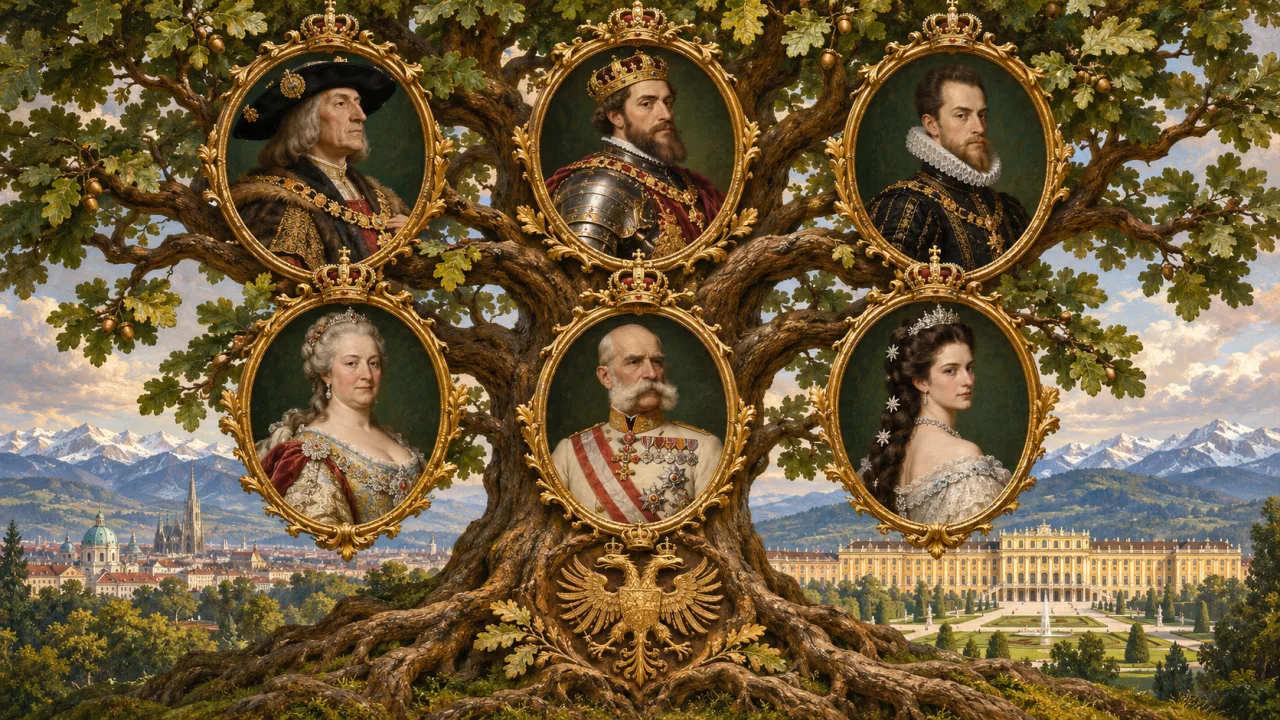
House of Habsburg Family Tree - Interactive Family Tree Visualization
Use arrow keys to move between people, Enter to open a person, Space to select, plus and minus to zoom, F to fit the tree.
Family overview
The story of House of Habsburg Family Tree
An editorial guide to the people, places, and turning points recorded in this lineage.
The Habsburgs were the most powerful dynasty in early modern Europe. They gained their lands less by conquest than by marriage: Maximilian I married the heiress of Burgundy, his son married the heiress of Castile and Aragon, and his grandson Ferdinand married into Bohemia and Hungary. By 1519 Charles V ruled Spain, the Low Countries, much of Italy, the Americas and the Holy Roman Empire.
This tree follows the dynasty from Maximilian I to the fall of the Austrian monarchy in 1918. It shows the split between Charles V's Spanish line and Ferdinand I's Austrian line, the repeated uncle–niece and cousin marriages that ended with Charles II of Spain, and the Austrian line through Maria Theresa and Habsburg-Lorraine to Franz Joseph I, Franz Ferdinand and the last emperor, Charles I.
About this tree
How this family tree was researched
Which version this tree follows
Labels use the common English form for each ruler (Charles V, Philip II of Spain, Franz Joseph I). The two Bavarian princesses called Maria Anna are told apart by their years. Maria Theresa's children belong to the House of Habsburg-Lorraine, which is shown in the surname field from that generation on. Charles II of Spain's pedigree is modelled in full back to Ferdinand I and Charles V, so each repeated ancestor appears once with several lines of descent.
What the tree leaves out
This is a selection, not the whole dynasty. Most children who did not continue a line or marry back into it are left out, including Don Carlos, Philip IV's first wife Elisabeth of France and her children, Emperor Joseph I and most of Maria Theresa's sixteen children. Maria Theresa of Naples and Sicily's father, Ferdinand I of the Two Sicilies, and Empress Elisabeth's parents are not shown, so the cousin links through them are explained in the descriptions instead. The Spanish line ends with Charles II, who had no children by either wife.
Family analytics
The lineage, by the numbers
A live summary calculated from the people and relationships currently recorded in this tree.
62
People
30
Male
32
Female
0
Unknown
0
Living
62
Deceased
16
Generations
30
Marriages
People
Notable family members
The people who shaped this family, and where each one sits in the tree.
His marriage to Mary of Burgundy in 1477 and the Spanish marriages he arranged for his children turned an Austrian house into a European power. All later Habsburgs in this tree descend from him.
Inherited Burgundy, Spain, the Spanish Americas and the Austrian lands, and was elected emperor in 1519. Worn out by war, he abdicated in 1556 and divided his inheritance between his son Philip and his brother Ferdinand.
Ruled Spain at its height and was briefly King of England as the husband of Mary I. His fourth wife, Anna of Austria, was his niece, and their son became Philip III.
Son of Philip IV and his niece Mariana. A 2009 genetic study calculated his inbreeding coefficient at 0.254, close to that of a child of a brother and sister. He died childless in 1700.
Succeeded her father in 1740 under the Pragmatic Sanction and defended her inheritance in the War of the Austrian Succession. Her marriage to Francis Stephen of Lorraine founded the House of Habsburg-Lorraine.
Came to the throne in the revolutions of 1848 and reigned for 68 years. He outlived his wife Elisabeth, his only son Rudolf and his nephew and heir Franz Ferdinand.
Succeeded his great-uncle Franz Joseph in 1916, in the middle of the First World War. He gave up his role in government in November 1918 and died in exile on Madeira in 1922.
Chronology
Family timeline
Filter major life events and follow the family story from its earliest dated record.
Recorded birthplaces, death places, and important locations reveal the family's geographic footprint.
Important places
Locations explicitly recorded in this tree
Vienna
28 people recorded
Madrid
9 people recorded
Graz
8 people recorded
Munich
7 people recorded
Lisbon
3 people recorded
Valladolid
3 people recorded
El Escorial
3 people recorded
Schönbrunn Palace, Vienna
3 people recorded
Family history
Family history, generation by generation
The major generations, marriages and turning points, in order.
1477–1516
Marriages, not wars
Maximilian I married Mary of Burgundy in 1477. Their son Philip the Handsome married Joanna of Castile, daughter of Ferdinand and Isabella. Early deaths in the Spanish royal family made Joanna heiress to all of Spain.
1516–1564
Charles V and the split
Charles V inherited Spain in 1516 and was elected emperor in 1519. His brother Ferdinand ruled the Austrian lands and gained Bohemia and Hungary through his wife Anna in 1526. When Charles abdicated in 1556, the dynasty divided into Spanish and Austrian branches.
1548–1661
Marrying within the family
To keep their lands together, the two branches married each other again and again. Philip II married his niece Anna, Philip III married his cousin Margaret, and Philip IV married his niece Mariana. Their son Charles II was born in 1661.
1700–1740
The end of the male line
Charles II died childless in 1700 and Spain passed to the French Bourbons after the War of the Spanish Succession. In Austria, Charles VI had no sons and issued the Pragmatic Sanction so that his daughter Maria Theresa could succeed him.
1740–1806
Habsburg-Lorraine
Maria Theresa ruled from 1740 and her husband Francis Stephen of Lorraine became emperor in 1745. Their sons Joseph II and Leopold II reigned in turn. Their grandson Francis II proclaimed the Austrian Empire in 1804 and dissolved the Holy Roman Empire in 1806.
1848–1918
Franz Joseph and the fall of the monarchy
Franz Joseph reigned from 1848 to 1916. His son Rudolf died at Mayerling in 1889, and his nephew Franz Ferdinand was assassinated in Sarajevo in 1914. Charles I, the last emperor, lost his throne when Austria-Hungary collapsed in 1918.
Sources
References
The relationships in this tree come from these sources. People and links that the sources don't confirm are left out.
His mother, Mariana of Austria, was his father Philip IV's niece. Philip III and Margaret of Austria were both his grandparents and his great-grandparents, and earlier uncle–niece marriages (Philip II and Anna, Archduke Charles II and Maria Anna of Bavaria) narrowed the pedigree further.
How were the Spanish and Austrian Habsburgs related?+
Both branches descend from Philip the Handsome and Joanna of Castile. Their elder son, Charles V, founded the Spanish line and their younger son, Ferdinand I, the Austrian line. The two lines then intermarried in almost every generation.
How was Marie Antoinette related to the Habsburgs?+
She was the youngest daughter of Maria Theresa and Emperor Francis I, so Joseph II and Leopold II were her brothers. Her great-grandfather Leopold I connects her to the older Habsburg line.
How was Franz Ferdinand related to Franz Joseph I?+
He was Franz Joseph's nephew, the son of his younger brother Archduke Karl Ludwig. He became heir after Franz Joseph's only son, Rudolf, died in 1889.
Who was the last Habsburg emperor?+
Charles I of Austria, son of Franz Ferdinand's brother Archduke Otto. He reigned from 1916 to 1918 and died in exile in 1922.
What does Habsburg-Lorraine mean?+
Maria Theresa was the last Habsburg by birth in the male line. Her husband, Francis Stephen of Lorraine, became Emperor Francis I, and their descendants are known as the House of Habsburg-Lorraine.
Start Building Your Family Story
Create a private tree, import an existing GEDCOM, or explore a complete demo before you begin.