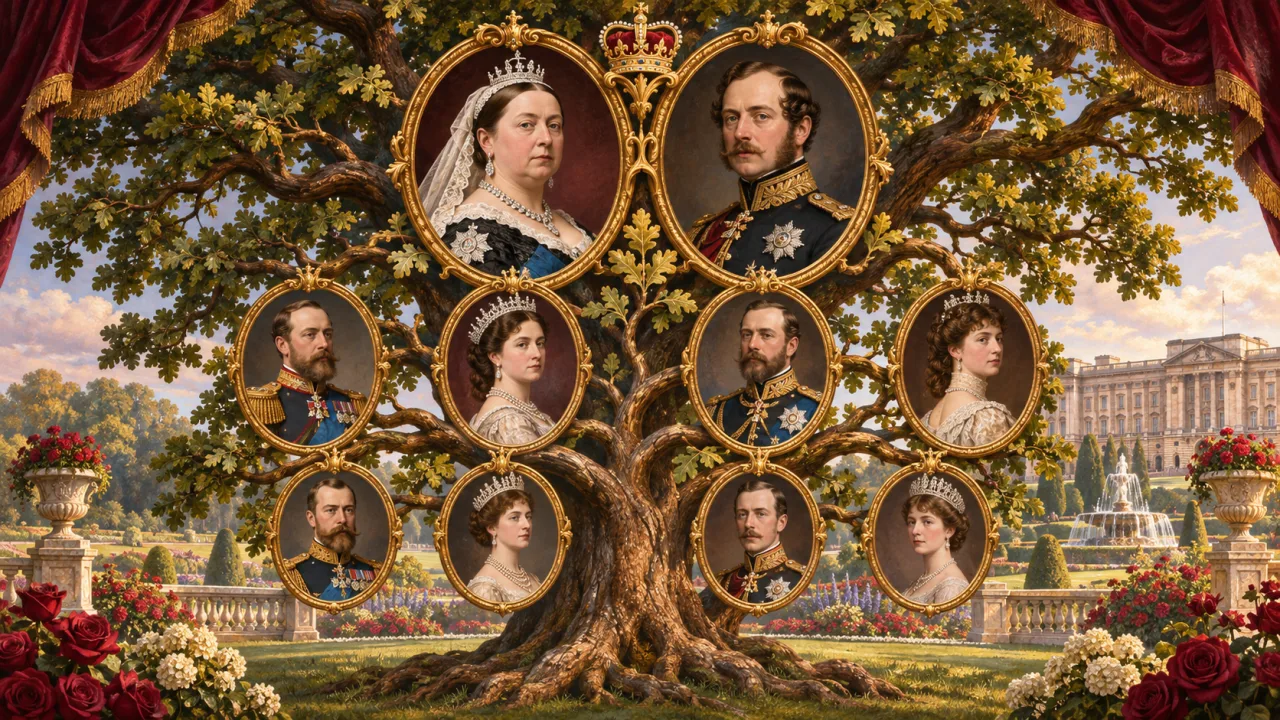
Queen Victoria's ancestry and descendants: her nine children, the grandchildren who ruled Germany, Russia and beyond, and the British royal line from Edward VII to King Charles III.
Queen Victoria Family Tree - Interactive Family Tree Visualization
Use arrow keys to move between people, Enter to open a person, Space to select, plus and minus to zoom, F to fit the tree.
Family overview
The story of Queen Victoria Family Tree
An editorial guide to the people, places, and turning points recorded in this lineage.
Queen Victoria reigned for 63 years, from 1837 to 1901, and her family reshaped the royal map of Europe. She and Prince Albert had nine children, and through their marriages Victoria's grandchildren became or married the monarchs of Germany, Russia, Greece, Norway, Romania and Spain. That reach is why she is often called the "grandmother of Europe".
This tree follows Victoria's own ancestry, including the shared Coburg grandparents that made her and Albert first cousins, all nine of their children with their spouses, the grandchildren who wore crowns, and the direct British line from Edward VII through George V, George VI and Elizabeth II to King Charles III.
About this tree
How this family tree was researched
What the tree leaves out
This tree covers one family, not every descendant: Victoria had 42 grandchildren, and her full line of descent is far larger. It keeps each generation to the people who carried a crown, a line of succession or the haemophilia story. The British line continues to the present day in the British Royal Family tree, and later Windsors are in the House of Windsor tree.
Family analytics
The lineage, by the numbers
A live summary calculated from the people and relationships currently recorded in this tree.
60
People
32
Male
28
Female
0
Unknown
1
Living
59
Deceased
8
Generations
23
Marriages
People
Notable family members
The people who shaped this family, and where each one sits in the tree.
Became queen at 18 on the death of her uncle William IV. Her reign saw the height of the British Empire, and in 1876 she took the additional title Empress of India.
Victoria's first cousin, a son of her mother's brother. He reformed the royal household, championed the Great Exhibition of 1851 and died of typhoid fever, according to the official diagnosis, at 42.
Waited almost six decades as Prince of Wales. His accession in 1901 began the House of Saxe-Coburg and Gotha in Britain, which his son George V renamed Windsor.
Descended from Victoria through Edward VII. Her husband Prince Philip was also Victoria's great-great-grandchild, through Princess Alice, so the couple were third cousins.
Recorded birthplaces, death places, and important locations reveal the family's geographic footprint.
Important places
Locations explicitly recorded in this tree
Kensington Palace, London
1 person recorded
Osborne House, Isle of Wight
1 person recorded
Schloss Rosenau, Coburg
1 person recorded
Windsor Castle
1 person recorded
Family history
Family history, generation by generation
The major generations, marriages and turning points, in order.
1818–1819
A succession crisis and two Coburg cousins
After the death of Princess Charlotte of Wales in 1817, George III's sons hurried to marry and produce an heir. Victoria was born in 1819 to the Duke of Kent and a Coburg princess. Albert was born three months later to her mother's brother, Ernest of Saxe-Coburg.
1837–1861
Queen, marriage and nine children
Victoria succeeded her uncle William IV in 1837 and married Albert on 10 February 1840. Their nine children were born between 1840 and 1857. Albert's death in December 1861 began Victoria's long, public mourning.
1858–1888
Marrying into Europe's royal houses
The children married into Prussia, Denmark, Hesse, Russia, Schleswig-Holstein and Battenberg. Their children in turn became the German Emperor, the Empress of Russia and the queens of Greece, Norway, Romania and Spain.
1853–1918
The "royal disease"
Victoria carried haemophilia. Her son Leopold had it, and her daughters Alice and Beatrice passed it on: through Alice to the Russian heir Alexei, and through Beatrice to the Spanish royal family.
1901–1936
Saxe-Coburg becomes Windsor
Edward VII succeeded in 1901. During the First World War his son George V, then fighting his cousin Wilhelm II, renamed the royal house Windsor in 1917. In the same year the Battenbergs anglicised their name to Mountbatten.
1936–present
Abdication and the modern monarchy
Edward VIII abdicated in 1936 and his brother became George VI. George VI's daughter Elizabeth II reigned for 70 years with Prince Philip, a fellow descendant of Victoria. Their son Charles III became king in 2022.
Sources
References
The relationships in this tree come from these sources. People and links that the sources don't confirm are left out.
Nine: Victoria (the Princess Royal), Edward VII, Alice, Alfred, Helena, Louise, Arthur, Leopold and Beatrice. All nine are in this tree with their spouses.
How is King Charles III related to Queen Victoria?+
Charles III is Victoria's great-great-great-grandson on both sides. Through his mother the line runs Victoria → Edward VII → George V → George VI → Elizabeth II. Through his father it runs Victoria → Alice → Victoria of Hesse → Alice of Battenberg → Prince Philip.
Were Queen Elizabeth II and Prince Philip related?+
Yes. Both were great-great-grandchildren of Queen Victoria, Elizabeth through Edward VII and Philip through Princess Alice, which made them third cousins.
Why is Queen Victoria called the grandmother of Europe?+
Her grandchildren included the German Emperor Wilhelm II, Britain's George V, Empress Alexandra of Russia, and the queens consort of Greece, Norway, Romania and Spain.
Were Queen Victoria and Prince Albert cousins?+
Yes, they were first cousins. Victoria's mother, the Duchess of Kent, was the sister of Albert's father, Ernest I of Saxe-Coburg and Gotha, so both were grandchildren of Francis, Duke of Saxe-Coburg-Saalfeld.
Start Building Your Family Story
Create a private tree, import an existing GEDCOM, or explore a complete demo before you begin.